Every new ad channel follows the same arc. At first, nobody believes in it. Then everyone talks about it without having tried it. And by the time the market catches up, the teams that tested early have already learned the lessons, and paid less for them than anyone else.
At Adkomo, performance acquisition is our core business. Each year, we invest several million euros in media across Meta, Google, Microsoft Ads, TikTok and native advertising. We use it to generate leads for advertisers in insurance, energy, telecom and financial services. So when ads arrived in ChatGPT, testing them was a given. The real questions were where to start and how much to put on the table.
We started with a vertical we know inside out: fiber and broadband lead generation in France. We generate over 20,000 telecom leads a month there, across every major channel. It’s a highly competitive market, and that volume gives us solid benchmark CPLs and conversion data on each source. That makes it the ideal testing ground to see whether a new channel brings something genuinely different, or simply resells the same audience at a higher price.
The test: €6 000 from September 16 to October 31 across 5 campaigns
Behind it, one simple question: is someone asking an AI for advice a better prospect than someone scrolling a feed? On paper, the intent is closer to search. The user expresses a need (“which fiber plan should I choose?”, “how can I cut my electricity bill?”) and is actively comparing options. But for us, the only valid proof is in the field:
- Real leads
- Delivered to real clients
- Called back by real call centers.
- Contact rate
- Contract signed
One caveat before the numbers: €6 000 is an early signal, not statistical truth. Read the results below as field feedback, not as a definitive verdict.
The results
Over the test period, ChatGPT Ads generated around 400 leads. They were delivered to three telecom advertisers and called back by their call centers. We compared them with the 19,700+ leads generated over the same period on all our other channels: Meta, Google, Microsoft Ads, TikTok, Snapchat, affiliation and emailing.
Lead cost: a premium channel
ChatGPT leads cost 23% more than our cross-channel average.
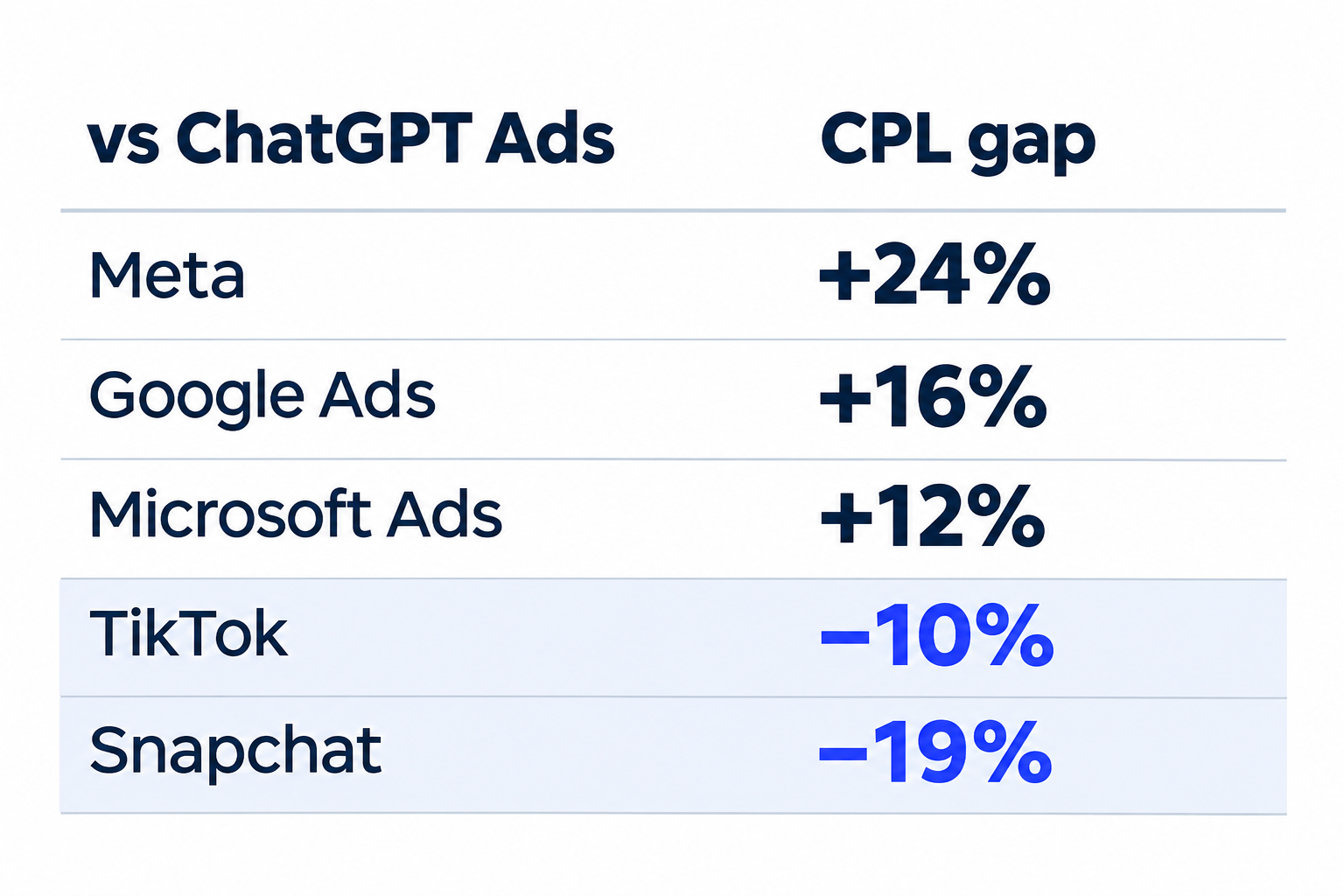
ChatGPT is not a cheap traffic source. It sits between search and short-video platforms, closer to Microsoft Ads than to Meta.
Phone number validity: every number checked
At Adkomo, we don’t take a phone number at face value. Every lead goes through an HLR (Home Location Register) lookup before it is delivered. In real time, we ask the mobile network whether the number exists, is active and can be reached. Numbers that fail are flagged and kept out of our clients’ call queues. Whatever the channel, our advertisers only call numbers we have already verified.
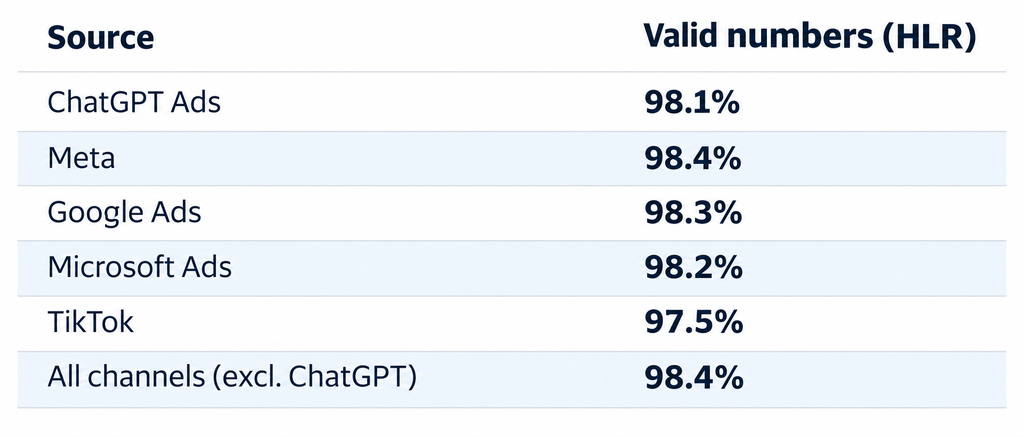
That check also gives us a clean, like-for-like quality signal across sources. We ran it on more than 41,000 telecom leads in France, including over 600 from ChatGPT Ads.
ChatGPT Ads is in line with the market. Fewer than 2 in 100 numbers fail the check, roughly the same as on Google and Microsoft Ads and better than TikTok. The channel doesn’t bring junk traffic or fake numbers. The people filling in our forms are real people who give their real phone number.
Lead quality: in line with the market, but uneven
The real question was whether this premium buys better prospects. Across all advertisers, ChatGPT leads converted into contracts at 3% below our average, which is essentially at par.
The advertiser-level view is more interesting:
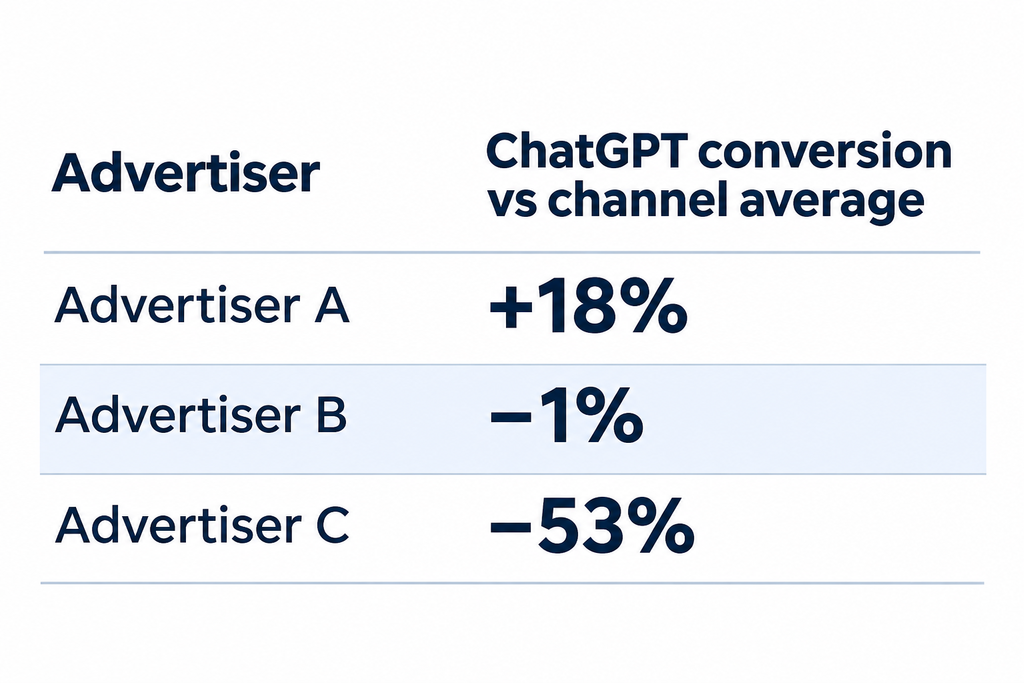
The same leads perform very differently depending on the call center behind them. The channel brings a different kind of prospect, and some sales teams are better equipped to convert them than others.
One more signal: when a ChatGPT lead signs, it signs for 19% fewer products than the average customer (fewer fiber + mobile bundles). These users seem to know exactly what they came for, and are less receptive to upsell.
The real surprise: the audience
This is where ChatGPT clearly stands apart.
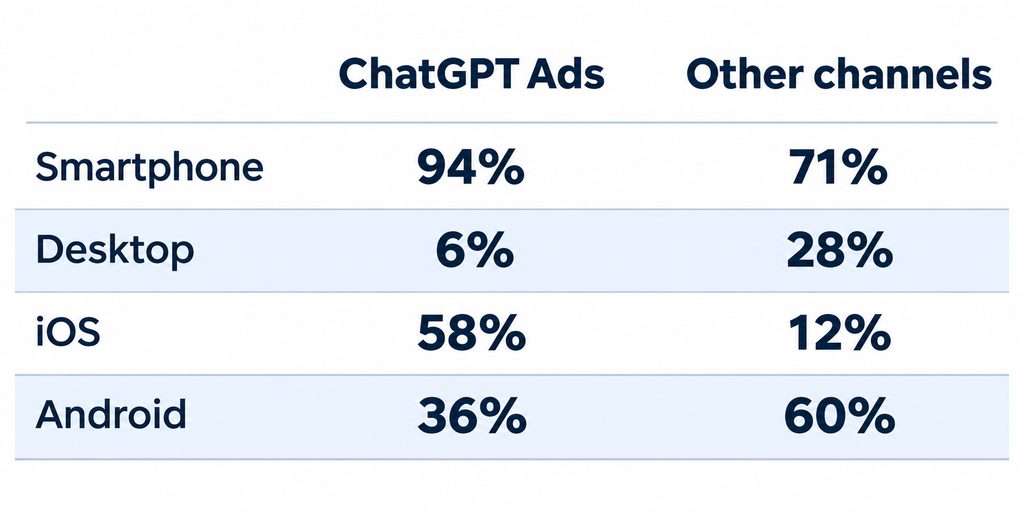
58% of ChatGPT leads come from an iPhone, nearly 5x our cross-channel average, and 6x Meta, where iOS is barely 10% of our leads. On top of that, 94% of them are on a smartphone.
For a performance marketer, this is the headline. iOS audiences are notoriously hard and expensive to reach on social since ATT, and here they show up naturally. They also convert better: on ChatGPT, iOS leads convert 59% better than Android leads, and 8% above our all-channel average. Android leads coming from ChatGPT are 32% below it.
But this audience profile also changes how you build your funnel. A landing page tuned for Meta’s Android-heavy traffic won’t necessarily perform the same here:
- Mobile-first, even mobile-only landing pages. With fewer than 6% of visitors on desktop, the desktop version is almost irrelevant. Short pages, thumb-friendly CTAs, the form above the fold, and fast loading on a 4G connection.
- Forms built for Safari and WebKit. Most of these users browse with Safari or ChatGPT’s in-app browser, both built on Apple’s WebKit engine. Fields need to trigger the right iOS keyboard (numeric for phone and postcode, email for email), work with iOS autofill and contact suggestions, and avoid components that behave badly on WebKit, such as custom dropdowns, date pickers and sticky elements that break when the keyboard opens.
- Fewer steps, less typing. Typing on an iPhone is where users drop off. Pre-filled fields, one-tap answers and multi-step forms with one question per screen work better than a long single form.
- Tracking under Apple’s privacy rules. Safari’s ITP and iCloud Private Relay limit cookies and hide IP addresses. If attribution relies on browser cookies alone, part of the conversions will go missing. Server-side tracking and click IDs passed through to the form become essential.
In other words, ChatGPT doesn’t just bring new prospects. It brings a different device mix, and funnels that were optimized for other channels need to be adapted before you scale.
What we take away
- ChatGPT Ads is not a cheaper channel. Expect to pay around 20–25% more per lead than on Meta or Google.
- Overall quality is at market level, not above it. The high-intent promise doesn’t automatically turn into more contracts.
- What it really offers is incremental reach: a mobile-first, iOS-heavy audience that our other channels barely reach.
- Results depend heavily on the buyer. Before scaling, match the channel with the call centers that know how to convert this profile.
Our recommendations
If you’re considering ChatGPT Ads for lead generation, here’s what we would do differently, or again:
- Start with a vertical where you have solid benchmarks. Without reliable CPL and conversion data from your other channels, you can’t tell whether ChatGPT brings something new or just costs more. Test where you already know what “good” looks like.
- Budget for a premium, and judge it on what it brings. Expect to pay 20–25% more per lead than on Meta or Google. The right question is not “is it cheaper?” but “does it reach people my other channels don’t?”
- Build for the iPhone first. With 94% of traffic on smartphones and 58% on iOS, your landing page and form must be designed for Safari and in-app browsing from day one. Use mobile-only layouts, native iOS keyboards and autofill, short multi-step forms and fast loading. A funnel copied from your Meta campaigns will leave conversions on the table.
- Fix your tracking before you spend. Safari’s ITP and iCloud Private Relay will quietly erase part of your attribution. Set up server-side tracking and pass click IDs through to the form, or you’ll be optimizing blind.
- Choose the right buyer for these leads. The same leads performed very differently from one call center to another. These prospects arrive informed and with a clear need. They respond better to a consultative pitch than to an aggressive upsell. Route them to the teams that know how to convert this profile.
- Don’t scale too early. Keep the test long enough to collect real contract data, not just leads. In our business, a lead is a cost. A signed contract is a result.
Conclusion
So, is someone asking an AI for advice a better prospect than someone scrolling a feed?
After this first test, our answer is: not necessarily better, but clearly different. ChatGPT Ads doesn’t deliver cheaper leads, and on average it doesn’t deliver more contracts either. What it does deliver is something increasingly rare in performance marketing: a new audience. It is mobile-first and largely on iPhone, with users who are reaching out at the exact moment they’re comparing options.
For an advertiser, that means incremental reach rather than a cheaper copy of existing channels. For us as an acquisition partner, it means one more lever to diversify volume and lower our dependence on the Meta/Google duopoly. It also lets us reach prospects our competitors aren’t reaching yet.
We’re still early. The ad formats will change, the auction will mature, and CPLs will move, probably upward as more advertisers join. That’s exactly why we test now. The teams that learn early are the ones who pay the least for what they learn.
What’s next
Fiber in France was the first chapter. We’re now extending the test to our other core verticals: energy suppliers, health insurance for seniors and financial services, as well as Spain. These are new markets, with new user intents and new call centers on the other end.
We’ll share those results the same way: real leads, real clients, real numbers.